
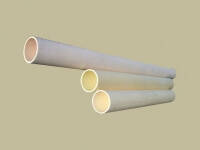
Custom High-Temperature Alumina Ceramic Tubes for Furnaces

Request a Quote
Alumina Tubes

When your furnace runs hotter than quartz can handle and your atmosphere is too aggressive for metal, alumina tubes are the answer. Sentro Tech manufactures high-purity alumina ceramic tubes for laboratory and production furnaces operating up to 1800°C, the temperature range where mechanical strength, dielectric performance, and gas-tightness all need to hold up at the same time.

Our standard alumina tubes are available in 99.5% and 99.8% purity, in diameters from 3/16″ to 9″ (2 mm to 150 mm) and lengths up to 72″ (1828 mm). Most stock items ship in 1–3 days; custom dimensions are quoted to your specs.

Why Engineers Specify Alumina Furnace Tubes

Alumina sits in a useful place between quartz (which tops out around 1100°C in continuous service) and silicon carbide (which is harder to machine to tight tolerances). For most high-temperature furnace work, it’s the default, and for good reason.

Mechanical Strength at Temperature

Our 99.8% alumina has a flexural strength of 70,000 PSI and a compressive strength of 370,000 PSI, with a maximum working temperature of 1800°C. The 99.5% grade has a 50,000 PSI flexural rating and rates to 1750°C. Both are gas-tight to ASTM dye penetration, which is important if you’re running vacuum or controlled-atmosphere processes where oxygen ingress would ruin a sample.

Dielectric Performance

At 300 V/mil (99.8%) or 270 V/mil (99.5%), alumina tubing meets the insulation requirements for high-voltage heating elements and instrumentation that would short out in lesser materials. This is what makes alumina tubes the standard choice for thermocouple protection and element sheathing.

Chemical and Abrasion Resistance

Alumina shrugs off most acids, alkalis, and reducing atmospheres at temperature. It’s also one of the hardest materials you’ll spec into a furnace, with a Mohs hardness of 9, just below diamond, so wear from samples, fixturing, or particulate flow isn’t a meaningful concern over a normal service life.

Thermal Conductivity Without Thermal Shock Vulnerability (Mostly)

Alumina conducts heat well enough to support uniform sample heating, but unlike quartz, it does not love rapid thermal cycling. The CTE is roughly 8 × 10⁻⁶/°C, which is low for a structural ceramic but high enough that aggressive ramp rates will eventually crack a tube.

Custom Alumina Tubing for Furnaces

Most of the alumina ceramic tubes we ship are non-standard in some way: a length cut to fit a certain furnace hot zone, a wall thickness specified for vacuum integrity, a closed-end configuration to protect a thermocouple. Send us your dimensions, drawing, or rendering, and we’ll come back with a quote and lead time.

If you’re trying to decide whether alumina, quartz, or silicon carbide is the right material for your application, our overview of ceramic tubing and how the major types compare explains the trade-offs. You can also browse our full lineup of ceramic tubing to compare materials side-by-side.

Request a Quote

Physical Properties of Alumina Tubes

Material ALUMINA  
Composition 99.80% AL2O3 99.5% AL2O3
Bulk Specific Gravity (g/cc) 3.9 3.8
Color Ivory Ivory
Impenetrability Gas Tight Gas Tight
Dye Penetration A.S.T.M. Tight Tight
Flexural Strength (PSI) 70,000 50,000
Compressive Strength (PSI) 370,000 350,000
Tensile Strength (PSI) 43,000 33,000
Maximum Working Temperature 1800°C 1750°C
Likely Sag Temp. Unsupported Tube* 1600°C 1600°C
Thermal Conductivity 24°C 230 200
BTU-in/ft2-hr-oF) 800°C 60 50
Dielectric Strength 24°C V/Mil 300 270
Thermal Expansion (per °C x 10-6) 8 8.4
(24°C-1000 °C)    
Hardness (Moh’s scale) 9 9

*Temperature at which an empty tube, 1 1/4″ diameter, suspended across an 18″ span, will sag 1/4″ in 1 hour.

Where sag is not acceptable, tubes must be adequately supported along the full length.

Standard Alumina Tube Dimensions

  Outside Dia. Inside Dia.
Part # inch mm inch mm
STT-0187 1/4 6.35 0.187 4.75
STT-0196 0.276 7.00 0.196 5.00
STT-0250 3/8 9.53 1/4 6.35
STT-0316 7/16 11.13 0.316 7.94
STT-0375 1/2 12.70 3/8 9.53
STT-0437 11/16 17.46 0.437 11.11
STT-0500 3/4 19.05 1/2 12.70
STT-0563 3/4 19.05 0.563 14.29
STT-0625 7/8 22.23 0.625 15.87
STT-0750 1 25.40 3/4 19.05
STT-0875 1 1/8 28.58 7/8 22.23
STT-1000 1.25 31.75 1 25.40
STT-1125 1 3/8 34.92 1 1/8 28.57
STT-1250 1 1/2 38.10 1 1/4 31.75
STT-1375 1 5/8 41.27 1 3/8 34.93
STT-1500 1 3/4 44.45 1 1/2 38.10
STT-1625 1 7/8 47.63 1 5/8 41.27
STT-1750 2 50.80 1 3/4 44.45
STT-1875 2 1/8 53.96 1 7/8 47.63
STT-2000 2 1/4 57.15 2 50.80
STT-2125 2 3/8 60.33 2 1/8 53.97
STT-2250 2 1/2 63.50 2 1/4 57.15
STT-2500 2 3/4 69.85 2 1/2 63.50
STT-2750 3 76.20 2 3/4 69.85
STT-2875 3 1/4 82.55 2 7/8 73.03
STT-3000 3 1/4 82.55 3 76.20
STT-3125 3 1/2 88.90 3 1/8 79.37
STT-3250 3 1/2 88.90 3 1/4 82.55
STT-3375 3 3/4 95.25 3 3/8 85.70
STT-3500 3 3/4 95.25 3 1/2 88.90
STT-3625 4 101.60 3 5/8 92.07
STT-4000 4 2/5 112.00 4 101.60
STT-4500 5 2/5 125.00 4 1/2 114.30
STT-5000 5 1/2 138.00 5 127.00

Frequently Asked Questions About Alumina Tubes

Should I choose 99.5% or 99.8% purity for my application?

For most furnace work below 1500°C, the 99.5% grade is the practical choice: same gas-tightness, same chemical resistance, lower cost. The case for stepping up to 99.8% is specific: higher mechanical strength (70,000 PSI flexural vs. 50,000), higher dielectric performance (300 V/mil vs. 270), and a higher working temperature ceiling (1800°C vs. 1750°C). If you’re insulating high-voltage heating elements, running near the upper temperature limit, or need every bit of structural margin you can get, 99.8% pays for itself. Below that, 99.5% does the job.

What ramp rate should I use to avoid thermal shock?

Alumina is tougher than most ceramics, but it’s not quartz, and you can’t quench it. As a general guideline, ramp at 5°C per minute or slower for both heating and cooling, especially through the first cycle of a new tube and across the 200–600°C range where thermal stress builds fastest. For larger-diameter tubes, slower is better. The exact safe ramp depends on tube geometry, wall thickness, and the temperature range you’re traversing. If you’re pushing the limits, send us your duty cycle, and we’ll talk through it.

Can these tubes reach 1800°C without sagging?

Reaching 1800°C, yes, the 99.8% grade is rated to that maximum working temperature. Holding shape there is a separate question. Our published sag temperature is 1600°C, defined as the point at which an unsupported 1-1/4″ tube spanning 18″ will deflect 1/4″ in 1 hour. Above that, the tube needs to be supported along its length to remain straight under its own weight or any sample load. For continuous operation near 1800°C, support fixturing isn’t optional.

Are these tubes gas-tight for vacuum or controlled-atmosphere use?

Yes. Both the 99.5% and 99.8% grades pass the ASTM dye-penetration test for gas-tightness, which is the relevant standard for vacuum and inert-atmosphere work. Fully dense alumina has effectively zero open porosity, so oxygen won’t migrate through the tube wall and contaminate a reducing-atmosphere process. The seal between the tube and your furnace flange is the more common failure point. Make sure your O-ring spec matches the OD tolerance of the tube you’re ordering.

What configurations are available?

The standard sizing table covers open-end tubes, which are the most common configuration for process work. Contact us with your dimensions, and we’ll confirm specs and lead time.

BBB Accredited Business Made in USA: American Product

Request a Quote from Sentro Tech

Fields marked with an * are required

Questions About Our Products? Contact Sentro Tech Today!

Contact a Sentro Tech representative today to learn more about our high-temperature furnaces.

Contact Us
Questions About Our Products? Contact Sentro Tech Today! Contact Us